
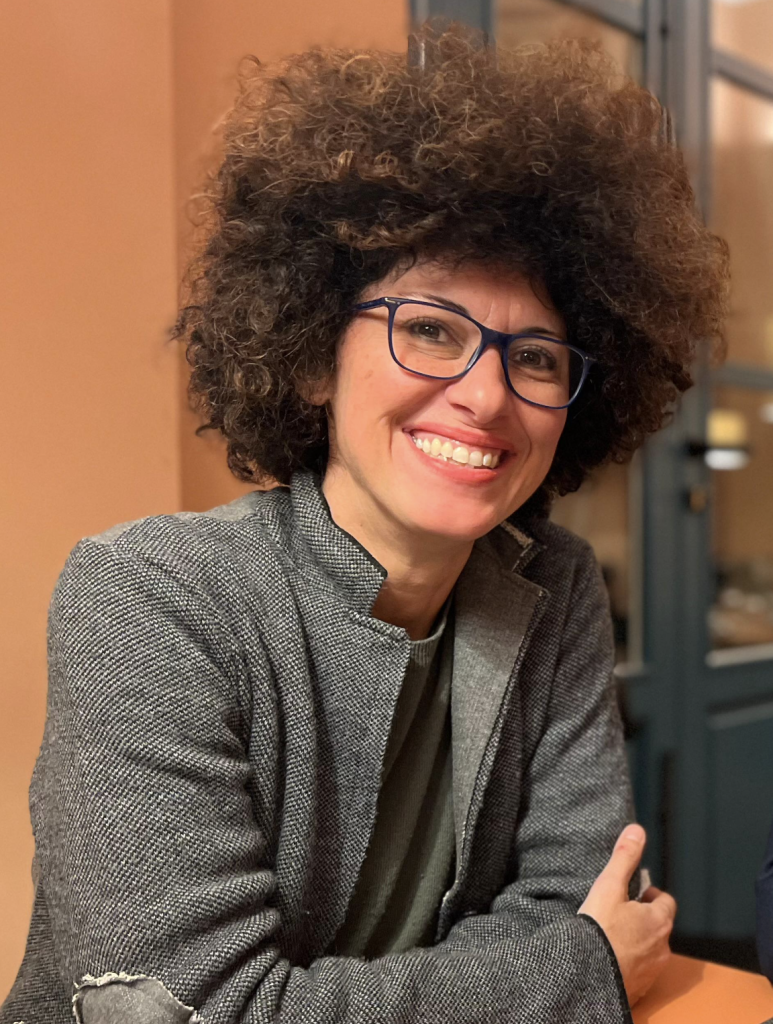
We met Lucia Lauro a little over four years ago when she was blazing a trail of social-entrepreneurship in the heart of Palermo’s Ballaro neighborhood – with Al Fresco Bistrot, Cotti in Fragranza, and Casa San Francesco Rooms. Now, she’s helping other social entrepreneurs improve their game as a strategic adviser and project manager with Fondazione Don Calabria. Her style is best described as regenerative leadership – centered on the Common Good.
What does regeneration mean to you on a personal level — and how does it shape your way of leading?
Regeneration is a model that influences leadership from the design and implementation of an intervention, to relational posture, to impact evaluation. To re-generate, for me, means to remain inside a continuous cycle in which what we think and build does not belong to us, but to the community.
It must be conceived as a gift, not as an exercise of power or ego.
A gift (munus) must have the characteristic of reciprocity — it cannot be something dropped down from above (a form of power expressed as charity or paternalism). It must be shared and must give the community and beneficiaries the possibility to participate and co-create the interventions.
In what ways does your organization contribute to the common good beyond its stated mission?
Our organization works deeply on themes of change and the construction of social trust. In none of our activities do we stop at the “outcome”; we always try to push one step further, toward building trust with indirect stakeholders. Working on issues of prejudice and exclusion through direct activities, cultural activities, and symbolic actions allows us to mend the fractures that marginalization always creates in the social fabric.
Tell us about your regenerative journey — what are you most proud of, and what are your next steps?
What makes me most proud is having avoided falling into the trap of success–ego–power that permeates today’s world of leadership. The social sector is not immune; quite the opposite. Those who lead social organizations can often feel like they are “saving lives,” and in this sense they live in a constant state of praise and myth-making. This often leads to a need to control everything and be present in every action of the organization.
I, instead, have trained myself to let go — to consider the activities I no longer oversee as a sign of success in my leadership. For the future, I would like to apply other important principles of leadership, such as fearlessness. I want an organization that feels free to express itself, with less performance anxiety and more creativity.
How do you define success — and how has this definition changed over time?
I believe that today the concept of success is still deeply tied to the money–power binary. Throughout my career, I’ve often experienced how counter-cultural choices regarding these two “organizational levers” are almost incomprehensible to most people. We have not yet made the cultural shift that allows us to understand that professional fulfillment comes from generativity. To be generative, to produce change, to build trust — these are the key words of success for me, and they all have to do with relationships. So for me, success is the ability to inhabit relationships in a generative way.
What are you doing to make your organization less dependent on external funding and more self-sustaining?
For many years we have been working to combine publicly funded projects with the production and sale of goods and services. Certainly, some of the people we work with struggle to contribute economically, even with their labor.
Activities such as the restaurant Al Fresco, the two confectionery production workshops, and the Casa San Francesco Rooms B&B are examples of initiatives aimed at community regeneration. Alongside this, we engage in extensive work with external companies, both regarding high-impact donations and social–workforce integration.
How do you ensure that power and voice return to the communities you serve?
The key word is participation. Our activities are planned with the beneficiaries, and they are the protagonists — in public — of telling the story of their own emancipation. We try to involve them in the narration of their stories so they become tangible examples of rebirth.
Moreover, we always position ourselves in listening mode with the community in which we live. For example, in Ballarò, we strongly felt the need for educational pathways for local youth, and so we decided to create a high school that would welcome them in a personalized way, paying attention to their educational needs.
How does equity manifest in your leadership practice — inside and outside the organization?
When we speak of equity, I like to start from the economic concept. In our organization, we have an equity principle whereby the highest salary cannot exceed twice the lowest salary, bonuses included. This is because, despite differing responsibilities, the principle remains that the organization is made up of many pieces — like a puzzle — and the absence of any one piece makes the beauty of the entire picture impossible, regardless of which piece is missing.
Then, equity in leadership requires knowledge of every employee individually, because one cannot be equitable by being generic. To be equitable, it is necessary to know individual needs, challenges, and stories, and to adapt work to the person as much as possible.
How do you balance urgency and patience — action and reflection — in your leadership?
Ah, a difficult question. I try not to sacrifice my personal time. I set many boundaries. This is because I believe that if we have the capacity to recharge emotionally and physically, we become more patient and can better understand what the true urgencies are.
I have trained myself over the last 25 years on organizational matters; I structure my days as though they were a diet that must include all the macronutrients. It doesn’t always work, but often it does.
For reflection, I use travel — it is a wonderful moment to step back, study, think, and dream.
What do you do to cultivate trust as a regenerative force?
I try to spend a lot of time with people; people give me trust, with all their difficulties. And when I am struggling, I think back to the past: to the child who once seemed lost but today is a father; to the young man who reoffended but then found a way out; or I go find a hug from one of the young people who work with us.
Strength, for me, comes from witnessing their power to change — and knowing that I played even a small part in that journey. This gives me joy and trust.
How do you encourage collaboration across silos, sectors, and personalities?
It is a great challenge. Organizations require structure, but structure often crushes communication and sharing. There are often communication gaps across hierarchical levels that wound people, undermine self-esteem, and create breakdowns.
I strongly believe in investing in internal communication and shared moments. A good leader should also highlight the mutual usefulness of connecting sectors and create interdependencies. It is not easy, and I’m not sure I’m fully able yet. It is certainly an area we are working on.
How do you avoid becoming part of the problem — replicating the same systems you seek to transform?
Many years ago a friend taught me that the key principle in relationships is compassion — suffering with the other — because sooner or later we will all hurt each other as human beings. This should encourage us to see conflict as a moment for growth in relationships.
For me, the key is empathy. In others’ behaviors, I try to see the intrinsic motivation, the unspoken need, or the need expressed poorly. I try not to get drawn into a tug-of-war; I try to let go of provocative demands.
Of course, sometimes it is necessary to meet conflict head-on when other approaches fail, but I try to minimize the moments when I must use aggression, hierarchy, or “I’m the one in charge.”
Another great tool is time. Our society has trained us to be hyper-reactive, always connected and ready. I have learned that — even if it frustrates others — taking time before responding, commenting, or directing is very useful for “cleaning” the decision of personal needs, fears, or emotions that have little to do with our responsibility.
What have you unlearned about leadership since embracing regeneration?
I have certainly unlearned the concepts of career and success as they were taught to me. Each of us inherits family and social expectations that trace out a predetermined path we feel compelled to follow. Inside this map sit the classic models of leadership.
I have especially abandoned the idea that working 14 hours a day was indispensable and made me more credible. Today, young people understand that life is made of many things and that work cannot be the absolute center of who we are. As leaders, we must confront this reality and find ways to reconcile business with people’s lives.
How do you measure value creation in terms of wellbeing, belonging, and dignity?
Measuring value is a significant commitment for any organization. Since 2021, we have begun a growth journey in this area, and I personally studied ESG social-impact assessment systems. Measuring value enables us to show how changes in the lives of the people we work with — their regained dignity through work — generate wellbeing not only for employees and trainees but for the entire community, especially the customers who choose our services. We often tell customers, “From today, you are also part of this change.”
Internally, we try to prioritize people’s wellbeing through small daily choices rather than major welfare policies. Our annual ESG impact report is one way of communicating this to stakeholders. Creating opportunities for employee exchange and sharing every step of our growth and vision is another. Belonging also grows from pride in results and the sense of contributing actively to progress.
How do you keep your organization human — especially under the pressure to grow or professionalize?
We always try to remember that growth should serve to give more people the chance to enter the workforce. This keeps us human because we do not imagine business as profit, but as the creation of greater value.
How does “regenerative governance” translate into practice for your team or board?
It translates into deep attention to the relationships among us, which produces open dialogue without fear that dissenting opinions will lead to judgment or exclusion. This increases creativity and the ability to prevent mistakes.
When we think about a strategy or a new project, we ask ourselves critical questions: “What change will it produce?” “Can it become sustainable?” “Does it respect our mission?”
How do you protect the integrity of your organization in the face of donor agendas or political pressures?
It’s important to do thorough strategic planning at the beginning of the year — dedicating time to analyze potential pressure points. When the boundaries are clear, it becomes easier to dialogue with external parties, justify our “no’s,” explain why common assumptions about rapid growth or immediate response do not align with our way of seeing enterprise, and dispel the myth that such assumptions are the only way to run an organization — using not only economic results but also social impact as evidence.
Tell us a story that represents regeneration in action within your organization or community.
The greatest regeneration is seeing that many young people who began working with us in conditions of marginalization are now starting families, having children, finding homes they have furnished step by step, beginning to travel, and developing their own aspirations.
Think of the chef in our restaurant: he started as an inmate on probation, then as an intern, then as a permanent employee assisting in the kitchen — and today he is the chef. He and his wife are expecting a baby soon, and they are building a future filled with trust.
How do you stay centered — personally — when the systems around you are in crisis or collapsing?
I have a personal network of loved ones and relationships who always support me in difficult moments. They help me remember that, as important as my work is to me, the center is not inside my professional world — and that if something fails, one can always start again.
I also believe it helps to stay aware that my contribution is not decisive; it is only a small part of a larger whole. I can do my part, but I cannot prevent failure or collapse. This brings me peace.
How do you prepare the next generation of leaders to continue the regenerative path?
I study a lot. I try to read as much as possible to add theoretical content to my practical experience. The example we set is the most important key, but in the future I would like to teach leadership to young people.
If your organization disappeared tomorrow, what regenerative effects would you want to remain?
Certainly the reduction of prejudice toward people at risk of marginalization — and therefore the trust in every human being’s possibility of change.
Thanks so much for all you do!
INTERVIEW by Christian Sarkar